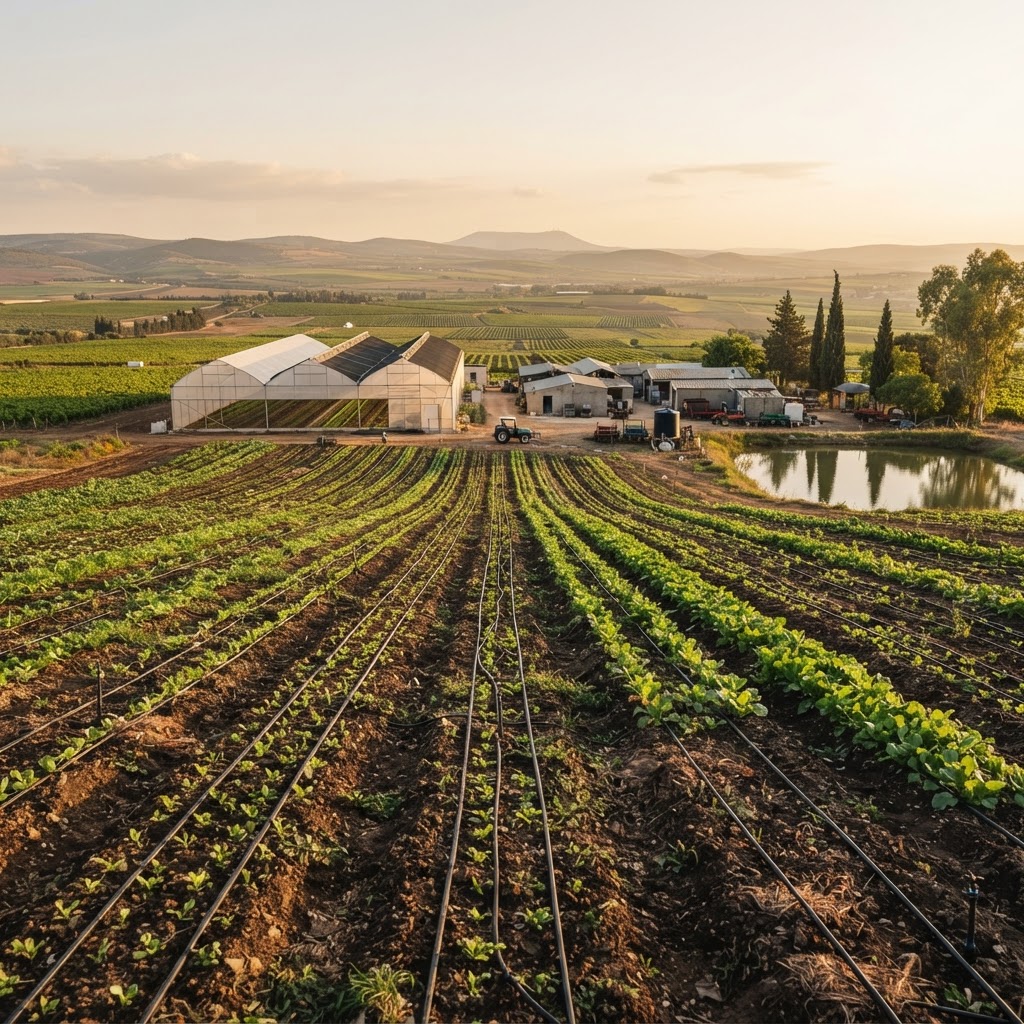
Solar power and storage for agricultural operations
A farm is a business whose electricity consumption is spread across several points: refrigeration, irrigation, buildings and packing areas. There is rarely a single answer here, but several separate decisions.
Request an agricultural suitability checkWhat is different about consumption on a farm
A farm consumes electricity differently from a factory or a logistics asset. These three characteristics shape how we work.
Several consumption points
Refrigeration, irrigation, buildings and packing areas are separate consumers, sometimes on separate connections and meters.
Farm structures on the land
Shelters, dairy buildings, poultry houses and other agricultural structures can host an installation, subject to an engineering review of the structure and its loads.
An asset that can generate income
For farms with suitable land, generating electricity can be an additional income stream alongside the farming activity — assessed separately.
The questions that come up on every farm
These issues determine how the assessment is carried out, so they are examined at the first stage.
Consumption spread across points
Separate points with separate metering make a single calculation difficult and require mapping before a system can be designed.
Seasonality of the activity
Cooling and irrigation needs change between seasons, so the gap against generation is not constant across the year.
Lightweight structures
Shelters and agricultural buildings are designed for different loads, so they are not automatically suitable for rooftop installation.
Distances and internal network
The distance between the generation point and the consumption points affects the electrical design and the cost of internal connection.
Where a farm usually starts
Work usually begins at the consumption point with the largest gap between generation and consumption.
Engineering and commercial considerations
On a farm with several consumption points, each point is reviewed separately and then as a whole.
Engineering review
- Reviewing each connection point and metering point separately
- Structural suitability of shelters, dairy buildings and farm structures
- Resistance to the environment — dust, spray, humidity and wind
- Designing the internal circuit between generation and consumption points
- Access for maintenance and cleaning around the farm routine
Commercial review
- Tariff structure at each of the consumption points
- How consumption is distributed across the seasons
- Whether to start at one point and extend later
- Combining self-consumption benefit with generation income
- Financing, depreciation and maintenance over system life
The assessment always follows the data of the farm. We do not publish example savings, capacity or income figures, and we do not commit to outcomes before the data has been reviewed and the required processes advanced.
Our delivery method on a farm
On farms we usually advance in stages, one consumption point at a time.
Conversation and orientation
The activity, income sources, ownership structure and what the owners want to move forward.
Site walkthrough and mapping
Reviewing consumption points, buildings and the infrastructure already on site.
Collecting data and measuring
Bills, meter data and measurements where needed, at the relevant consumption points.
Reviewing the routes
Generation on structures, storage, or referral to an agrivoltaics assessment where dual land use is involved.
Design, licensing and delivery
Supporting the processes through to operation, including projects advanced in stages and extensions.
What is worth preparing before the farm suitability check
On a farm, the initial mapping of consumption points produces the greatest value.
Farms with land suitable for dual use will be referred to a separate agrivoltaics assessment. That assessment has its own agronomic and planning aspects.
Frequently asked questions
Related pages
Where the assessment continues
Let us assess the suitability of your farm
Send us the farm details, the consumption points and the electricity bills, and where the land is suitable we will also refer you to an agrivoltaics assessment.